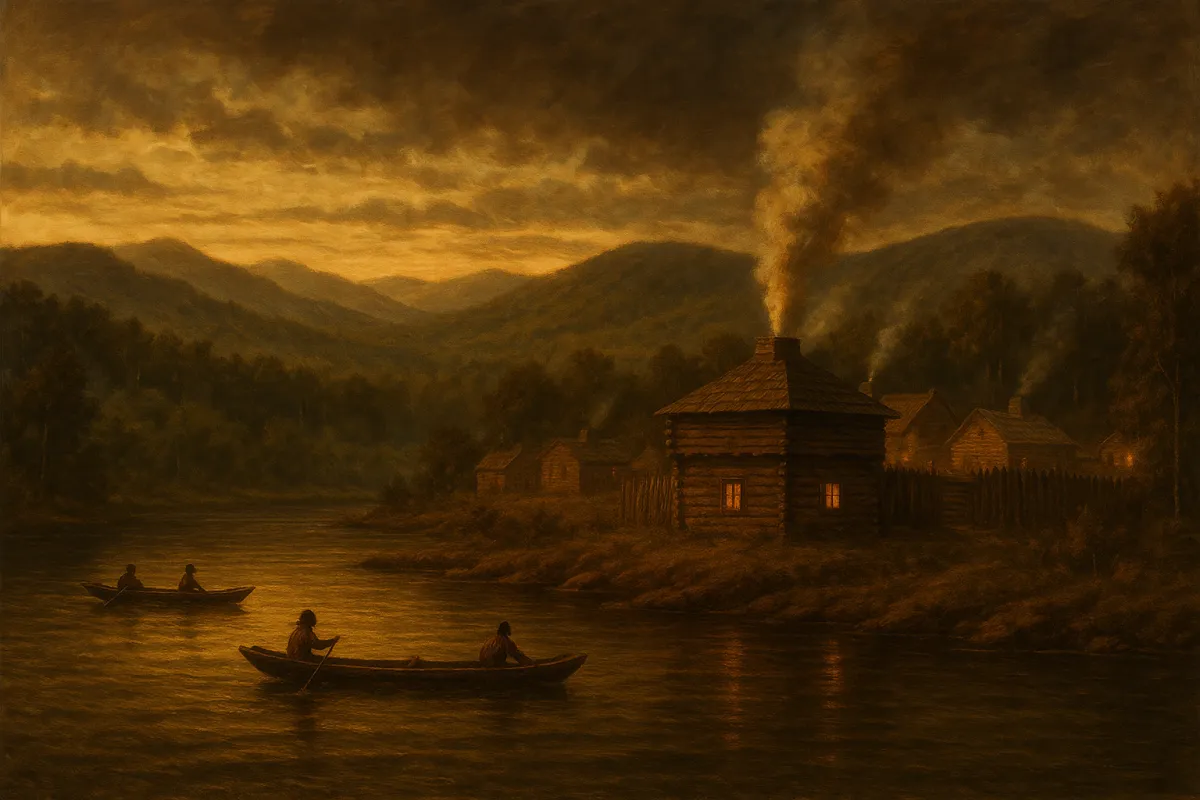
Before the lottery, before the name, before the map -- here is what this place actually was.
The official founding date of Knoxville is October 3, 1791. That is the day James White's son-in-law Charles McClung had surveyed the land and divided it into 64 half-acre lots, a lottery was held for those wishing to purchase them, and the place officially became a city on paper -- named, platted, and pointed toward a future. It is a tidy origin story. Satisfying in its specificity.
But a single date is always a simplification. And 1791 in particular contains layers that the official story tends to flatten: a treaty negotiated under a canopy tent on a riverbank, a name given to honor a man who never set foot here, a Cherokee word for mulberry trees that predates every European map of this territory by centuries, and Native American mounds still present in Knoxville's neighborhoods today that were ancient long before the first English-speaking settler arrived.
This is the fuller story of 1791. And it begins much earlier than 1791.
Before the Name: Kuwanda'talun'yi
Long before anyone called this place Knoxville -- before it had any English name at all -- the Cherokee called the area along this wide river bend kuwanda'talun'yi. It means Mulberry Place.
Most Cherokee habitation in the area was concentrated in what American colonists called the Overhill settlements along the Little Tennessee River, southwest of what would become Knoxville. But the landscape that is now downtown Knoxville and the surrounding county was known, named, and traveled by the Cherokee for generations. The Tennessee Valley had been inhabited by Native American peoples for thousands of years. Substantial Mississippian period village sites dating from roughly 1100 to 1600 AD have been found along the river near the Knox-Blount county line and at Bussell Island near Lenoir City. There is significant evidence that Spanish explorer Hernando de Soto visited the area in 1540 -- some historians believe his expedition passed through these valleys on its way toward the Mississippi River.
The mounds are still here. An ancient burial mound near the corner of Joe Johnson and Chapman Drive on the UT Agricultural Campus was built as early as 644 AD by Native Americans of the Woodland Period. The mound along Cherokee Drive in Sequoyah Hills -- where joggers run and the walking trail passes right over it -- once overlooked a large village between the mound and the Tennessee River. Long before settlement, and probably long before the Cherokee themselves, other Native Americans resided there. When you walk the Sequoyah Hills greenway today, you are walking over the remnants of a civilization that predates Knoxville by more than a thousand years.
The first major recorded European presence in the Knoxville area was the Timberlake Expedition in December 1761, when British soldier Henry Timberlake led a peace expedition to the Overhill towns and passed through the area at the confluence of the Holston and French Broad rivers -- the exact spot where they join to form the Tennessee. He was not the first outsider to notice that this confluence was a place worth remembering.
James White's Fort: 1786, Not 1791
The date most people cite -- 1791 -- is not actually when the first European settlers arrived here. That happened five years earlier.
The first European settlement in Knoxville was established by North Carolina Revolutionary War veteran James White in 1786. White and a fellow explorer named James Connor built what became known as White's Fort -- a cluster of four strong log cabins connected by a tall fence, positioned strategically on a hill with the river to the south and creeks on the east and west. White had been part of an 1783 expedition that explored the Upper Tennessee Valley and identified the future site of Knoxville; he took out a land claim shortly afterward and moved there three years later.
The compound was truly an outpost in a wild frontier -- a contested wilderness where white settlers fought regular battles with Cherokee warriors, and in which daily life was a struggle for survival. White's Fort sat at the western edge of what settlers briefly called the State of Franklin -- a breakaway state that Tennessee settlers tried to form in 1784, which the U.S. government never recognized.
So the story of what became Knoxville begins in 1786, in a log fort on a river bluff. Not in 1791. But what happened in 1791 transformed that fort into a city.
The Treaty Beneath the Tent: July 2, 1791
The founding of Knoxville owes as much to a treaty negotiation as it does to a real-estate lottery. And that treaty contains one of the most consequential ironies in the city's founding story.
In 1790, North Carolina ceded its Trans-Appalachian territory to the federal government. President George Washington created the Southwest Territory and appointed William Blount, a signer of the U.S. Constitution from North Carolina, as its governor. Blount's first task was to resolve the persistent land disputes between the Cherokee and white settlers, many of whom had settled on Cherokee land illegally.
What happened next reads like a scene from a novel. The governor wore a full-dress military uniform and sword. The Cherokee leaders, resplendent in their finest attire, performed an Eagle Tail Dance to demonstrate their strength and resilience. The Cherokee believed Blount was there to discuss the failure of the U.S. government to make settlers respect the terms of previous agreements. Blount entered the negotiations with the main goal of purchasing more Cherokee land. The elders were so put off by Blount's obsession with land that they reportedly called him the Dirt Captain behind his back.
In the summer of 1791, Blount met with 41 Cherokee chiefs at the mouth of First Creek -- the same creek whose mouth is now marked by a statue at Volunteer Landing -- and negotiated what became the Treaty of Holston, signed on July 2, 1791. The treaty moved the boundary of Cherokee lands westward to the Clinch River and southwestward to the Little Tennessee River.
Here is the irony at the heart of Knoxville's founding: Blount's original intention had been to place his territorial capital at the confluence of the Clinch and Tennessee rivers -- near modern-day Kingston, where he personally held land claims. But he was unable to convince the Cherokee to completely relinquish that area. And so, because the Cherokee refused to give up his first choice, Blount settled on White's Fort as the capital instead.
Knoxville exists where it does, in part, because of Cherokee resistance.
A statue commemorating the Treaty of Holston stands on Volunteer Landing today, by the mouth of First Creek. Most people walk past it without knowing what they are walking past.
October 3, 1791: The Lottery, the Name, and the Sixty-Four Lots
Following the treaty, Blount directed James White to set aside land for a new town. White's son-in-law Charles McClung surveyed it and divided it into 64 half-acre lots -- the area now roughly bounded by Church Avenue, Walnut Street, First Creek, and the river in what is now Downtown Knoxville.
Lots were set aside for a church and cemetery, a courthouse, a jail, and a college. The street names were borrowed from Philadelphia and Baltimore -- a detail that reveals the ambitions of this frontier capital, which was attempting to project civic permanence into a landscape of log structures and contested borders.
On October 3, 1791, a lottery was held for those wishing to purchase lots. The city was named Knoxville in honor of Blount's superior, Secretary of War Henry Knox -- a Revolutionary War general and Washington's first Secretary of War who had never been to East Tennessee and would never visit the city that bears his name. Naming the capital for him was practical politics dressed as honor.
Among those who purchased lots in the first lottery: merchants, a newspaper publisher, a minister, and a tavern owner. The mix tells you everything about what kind of frontier city this was going to be.
The First Months of an American Capital
The speed with which the new city assembled itself is remarkable. Within weeks of the lottery, Knoxville already had a newspaper.
The city's first newspaper, the Knoxville Gazette, was established by George Roulstone in November 1791 -- just one month after the founding lottery. It was the first newspaper in the territory that would become Tennessee, and only the third American newspaper west of the Appalachians. The early issues were reportedly full of news of murder, theft, and attacks by hostile Cherokee -- an accurate reflection of how precarious the new settlement actually was.
Knoxville was tiny in those first months, with only a few hundred residents and very little permanent architecture. But it was one of only 17 capital cities in the new United States, and for that reason it was sometimes mentioned in the European press.
By August 1792, the Cowan brothers had opened the city's first general store. By December 1792, John Chisholm's tavern was in operation. A garrison of federal soldiers erected a blockhouse in 1792. In 1793, the town and a U.S. Army fort near the present corner of Gay and Main Streets came under attack by Creeks and Chickamauga Cherokee -- a group that had refused to recognize the Holston treaty -- and would reportedly have been overrun if the attackers had pressed their advantage. A visitor who passed through in 1794 noted that Knoxville had many taverns but no churches. In 1794, Blount College was chartered -- the forerunner of the University of Tennessee.
One footnote from the historical record is too good to omit: an old soldier's manuscript account describes a militia company camped for six weeks near a creek west of the early town. The soldiers, the account says, wrestled so much as to give the place the name of Scuffletown, which it yet bears. The scruffiness, apparently, goes back to the very beginning.
1796: Tennessee Is Born in Knoxville
Within five years of the founding lottery, Knoxville was central to a movement to create a new American state. In January 1796, representatives from across the Southwest Territory met in Knoxville to draw up a constitution for a new state -- to be known as Tennessee, a Cherokee word for the river that flows through much of the state. On June 1, 1796, Tennessee was admitted to the Union as the 16th state. Knoxville became Tennessee's first capital.
The founding of Knoxville predates the creation of the state by nearly five years.
Blount's mansion -- the first frame house built west of the Appalachian Mountains, constructed in 1792, still standing today on Hill Avenue -- had served simultaneously as the governor's residence and the territorial and state capitol building. Knoxville maintained its capital status through 1812, briefly again in 1818, before the legislature moved to Middle Tennessee. After losing its original purpose, the city entered a period of stagnation that lasted until railroads arrived in 1855 and triggered the industrial growth that finally gave the city permanent bones.
What 1791 Looks Like Today
Walk downtown Knoxville today and the founding year is closer than it seems.
Blount Mansion still stands at 200 West Hill Avenue -- the oldest surviving structure connected to the founding of the city and the state of Tennessee. It is a National Historic Landmark and is open for guided tours. Built in 1792, it is one of the first frame houses constructed west of the Appalachian Mountains.
James White's Fort, recreated about 600 yards from its original site at 205 East Hill Avenue, includes the original 1786 cabin of General James White. It is open to the public and furnished with tools and artifacts of the period.
The Treaty of Holston statue at Volunteer Landing marks the location of the July 2, 1791 negotiations that set everything in motion. Stand there and look upriver. The confluence of the Holston and French Broad is upstream, where the Tennessee River is formed. Henry Timberlake passed through that spot in December 1761. The Cherokee had a name for this place long before that.
The mounds are still here too, if you know where to look. The Sequoyah Hills mound on Cherokee Drive. The burial mound on the UT Agricultural Campus. The landscape carries its history in earthworks that predate the city by centuries.
The City That Knoxville Already Was
The official founding date of October 3, 1791 is real. The lottery happened. The lots were sold. The name was given. A newspaper launched within the month. A college followed within three years. A state was born here five years later.
But the place that became Knoxville was a river confluence that Native American peoples had named, traveled, and built upon for thousands of years before James White drove a stake into its ground. It was a diplomatic stage where a governor in a military uniform and Cherokee elders in ceremonial dress negotiated a treaty whose terms both sides interpreted differently from the moment the ink dried. It was a capital city named for a man who never visited it. It was one of 17 capital cities in a brand-new nation -- and the only one built on land its own founders acknowledged even while dispossessing.
The founding year of 1791 is a beginning. But what was here before 1791 is also the story of Knoxville. The mulberry place. The river confluence. The mounds. The negotiated treaty. The full weight of all the layers underneath.
In Knoxville, the past and present stand side by side. They always have.
Explore more of Knoxville's deep history at Knoxville Right Now.
