How a scruffy little city on the Tennessee River pulled off one of the most ambitious events in American history -- and what it left behind.
In the summer of 1982, something genuinely unlikely happened in Knoxville, Tennessee. A mid-sized Appalachian city that a major national newspaper had recently dismissed as a scruffy backwater opened its doors to 22 nations, 11 million visitors, and the eyes of the entire world. Six months later, when the gates closed, Knoxville had proved every skeptic wrong -- and set in motion a transformation of its downtown that is still unfolding today.
This is the full story of the 1982 World's Fair -- officially known as the Knoxville International Energy Exposition -- from the idea born in a struggling downtown to the golden tower that still dominates the city's skyline.
The Idea: A Downtown in Trouble and a Man Who Saw a Solution
The story begins not in 1982, but in 1974, in Spokane, Washington.
Downtown Knoxville in the mid-1970s was struggling. Anchor retailers were abandoning the urban core for suburban malls. Both surviving downtown movie theaters were about to close. The city felt like it was losing ground to its own outskirts. W. Stewart Evans, a retired Air Force colonel who had taken over as director of the Downtown Knoxville Association, made a trip to the 1974 Spokane World's Fair -- an event that Spokane, a city roughly Knoxville's size, had used to catalyze its own downtown revival. Evans came back with an idea.
In November 1974, Evans formally proposed the idea of a Knoxville World's Fair to city government and local business owners. He cited a compelling case: Knoxville's association with energy research and development, spurred by the Tennessee Valley Authority (TVA), Oak Ridge National Laboratory (ORNL), and the University of Tennessee, made it a natural host for an energy-themed exposition. The timing was perfect. The Energy Crisis of the 1970s had made energy the defining issue of the decade. Knoxville had the credentials, the geography, and the institutional backbone to host the conversation the world was already having.
It took years of planning and civic arm-twisting. Jake Butcher, a powerful Knoxville banker, became the driving financial force. Mayor Kyle Testerman committed the city. The federal government pledged an additional $224 million in federal and state funding for transportation infrastructure improvements, including completion of the I-640 semi-beltway and improvements to the infamous "Malfunction Junction" interchange.
When the proposed site was announced, businesses and residents protested the taking of their property, holding rallies and calling for a referendum. The prospect of the fair had captured the city's imagination. It went forward.
The Site: Turning a Railroad Yard Into a World Stage
Located along the Second Creek watershed between downtown Knoxville and the University of Tennessee campus, the roughly 70-acre disused Louisville and Nashville Railroad (L&N) railyard was selected as the site for the exposition. The railyard was demolished to make way for the nation-representing pavilions, the Tennessee Amphitheater, and the Sunsphere. The existing L&N station and foundry were renovated to hold restaurant spaces, offices for fair officials, and VIP rooms. More than 3,000 UT students worked for the fair, pavilions, exhibits, or concessions.
The Sunsphere: A Monument to the Sun
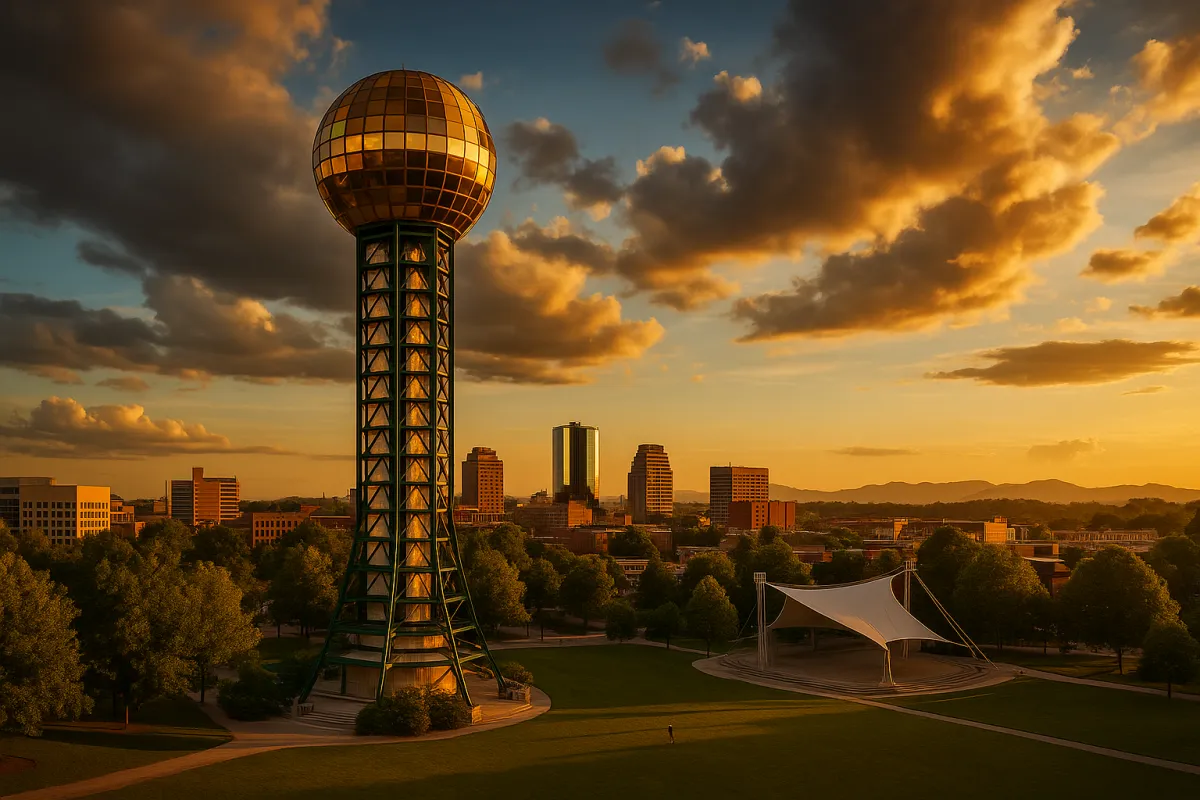
No structure defines the 1982 World's Fair more than the Sunsphere -- and no structure has become more inseparable from Knoxville's identity.
The Sunsphere is a 266-foot-tall steel tower topped with a five-story gold globe, designed by Knoxville-based architectural firm Community Tectonics -- the same firm responsible for the Clingmans Dome Observation Tower in Great Smoky Mountains National Park. Officially named A Monument to the Sun, Source of All Energy, it followed the tradition of iconic World's Fair observation towers: the 1889 Eiffel Tower, the 1962 Space Needle, and the 1968 HemisFair Tower in San Antonio.
The gold globe itself is 5 stories tall and each pane of glass is made of 24-karat gold dust. There are 360 energy-efficient panes, cut into seven different shapes, each costing an average of $1,000 at the time of construction. The entire structure weighs approximately 600 tons. Believed to be the first climate-controlled spherical building in the world, the Sunsphere has a patented structural design heralded in multiple engineering publications. During the fair, visitors paid $2 to ride one of three high-speed glass elevators to the Sunsphere's two observation decks, VIP lounge, and full-service restaurant.
The Wall Street Journal and the Scruffy Little City
Before a single ticket was sold, Knoxville had to survive its most famous insult. On December 29, 1980, the Wall Street Journal ran an article headlined What If You Gave A World's Fair And Nobody Came? -- calling Knoxville a scruffy little city of 180,000 on the Tennessee River. Time, Newsweek, and even Nashville's Tennessean piled on.
The negative publicity, however, brought out the I'll show you spirit and stiffened local resolve. The phrase appeared on T-shirts during the fair itself. When the gates closed on October 31, 1982, fair officials created commemorative buttons that stated: The Scruffy Little City Did It.
Opening Day: May 1, 1982
President Ronald Reagan opened the fair at the Court of Flags on May 1, 1982, with actress Dinah Shore serving as master of ceremonies. As the gates opened, there were performances by Porter Wagoner and Ricky Skaggs. Notable guests included Bob Hope, Philippines President Ferdinand Marcos and First Lady Imelda Marcos, and Crown Prince of Jordan Hassan bin Talal. Opening day drew 87,659 visitors. Opening week saw 387,697. An adult ticket cost $9.95 -- while a first-class stamp was 20 cents, a gallon of gas was $1.30, and the median U.S. household income was $20,171.
What Was Inside: 22 Nations and a Glimpse of the Future
Participating nations included Australia, Belgium, Canada, China, Denmark, Egypt, France, Greece, Hungary, Italy, Japan, Luxembourg, Mexico, the Netherlands, Peru, the Philippines, Saudi Arabia, South Korea, the United Kingdom, the United States, and West Germany. More than 50 private organizations and companies also mounted exhibits.
China's Historic First Appearance
Perhaps no pavilion generated more wonder than China's. China made its first-ever appearance at a World's Fair in Knoxville -- bringing actual bricks from the Great Wall of China and artisans carving jade in person. In the early 1980s, China was still very much a closed book to most Americans. The longest lines at the entire fair were at the Chinese Pavilion.
The Technology That Changed Everything
The fair introduced new innovations that would reshape daily life:
- Touchscreens -- IBM debuted a Computer Display that allowed people to touch the screen to get information. Visitors were baffled. It felt like science fiction.
- Cherry Coke -- Coca-Cola debuted the flavor at the fair.
- Texaco's Pay at the Pump -- The concept that transformed gas stations was introduced here.
- Shelf-stable milk -- Another fair debut.
Hungary's Giant Rubik's Cube
The Hungarian Pavilion featured a 10-foot-tall, 1,200-pound motorized Rubik's Cube that actually turned. It is now housed at the Knoxville Convention Center.
Peru's Controversial Mummy
One of the more unexpected exhibits was the public and controversial unveiling of a Peruvian mummy -- generating considerable debate about the ethics of displaying human remains as entertainment.
The Midway and Entertainment
The fair's midway included the Great Wheel, the tallest Ferris wheel in the world at the time, plus a gondola system connecting exhibit areas and an arcade featuring Pac-Man and Donkey Kong. Entertainment throughout the fair's six months included Bob Hope, Johnny Cash, Willie Nelson, Loretta Lynn, Merle Haggard, and Debbie Boone. The Tennessee Amphitheater hosted country and classical concerts, Broadway shows, world-renowned orchestras, ballet, and opera companies.
The Numbers: What It Cost and What It Made
The 1982 Fair cost the City of Knoxville $46 million in bonds -- debt paid off in May 2007, two years early. By October 31, 1982, 11,127,786 visitors had passed through the turnstiles. The fair earned the city $25 million in tax revenue and generated an estimated $500 million in tourism revenue. Total profit: exactly $57 dollars. It was the last successful World's Fair held in America -- and the first ever held in the South.
The Aftermath: A Complicated Legacy
One day after the fair ended, federal bank examiners took control of Jake Butcher's 22 banks. In February 1983, United American Bank of Knoxville became the first to be declared insolvent. Eight more followed -- the biggest set of bank failures in the United States since the Great Depression. Plans for renovating the fair site collapsed. By 1984, a New York Times reporter described the desolate legacy of the fairgrounds, popular mainly with local joggers. Pavilions were gradually demolished. The U.S. Pavilion was imploded in 1991.
The Long Redemption: World's Fair Park Today
The site's revival was slow, unglamorous, and ultimately successful. The Knoxville Convention Center was built on the eastern side of the fair site in 2002, and World's Fair Park was relandscaped across the northern portion that same year. Renovation was completed in 2003. In 2007, the Sunsphere's observation deck reopened to the public. The Tennessee Amphitheater, condemned for demolition in 2002, was renovated between 2005 and 2007 and was voted one of the top 15 architectural works of East Tennessee by the East Tennessee chapter of the American Institute of Architects.
World's Fair Park today is a 10-acre urban oasis with sprawling lawns, water features, a playground, the Veterans Memorial, the Sunsphere, and the Convention Center. The Knoxville Museum of Art and the L&N STEM Academy surround the park. An Independence Day celebration is held on the lawns every year, with the Knoxville Symphony Orchestra performing a free concert alongside a massive fireworks display. Petro's Chili and Chips -- born at the fair as Petroleum Belly -- has grown to about 30 locations across the mid-South, still run by the same family.
What the Fair Actually Did for Knoxville
The fair forced the city to modernize its infrastructure in ways that paid dividends for decades. The transportation improvements alone changed how the city functioned. The long-neglected riverfront became the site of Volunteer Landing's greenway, connecting downtown to the Third Creek Bike Trail. But perhaps more importantly, the fair changed what Knoxville believed about itself. Before 1982, Knoxville was often described as simply a gateway to the Smokies -- a place you passed through on the way somewhere else. After the fair, the city had demonstrated it could organize, invest in itself, welcome the world, and produce something genuinely remarkable.
As one downtown development leader later reflected: For a little town like this to be able to have that, to get that recognition, have those events going on -- really was a coming of age for us.
The Sunsphere remains. The amphitheater still hosts concerts. The park is still where the city gathers on July 4th. And the phrase The Scruffy Little City Did It still captures something true about what happened here -- a city that was told it was too small, too rough, too provincial to host the world, and proceeded to do exactly that.
Sources and Further Reading
- World's Fair Park -- Official History and Fun Facts
- Wikipedia: 1982 World's Fair
- City of Knoxville -- Official 1982 World's Fair Page
- Knoxville History Project -- 40th Anniversary Coverage
- Knoxville History Project -- The World's Fair in Hindsight
- University of Tennessee -- 1982 World's Fair 40th Anniversary Exhibit
- SAH Archipedia -- The Sunsphere
- Visit Knoxville -- World's Fair Anniversary
- WBIR -- Remembering the 1982 World's Fair
- UT Daily Beacon -- Remembering the World's Fair
- New York Times (1984) -- The Desolate Legacy of Knoxville's World's Fair
Explore more of Knoxville's deep history at Knoxville Right Now.
