Every old city accumulates stories it cannot quite explain. Knoxville has accumulated more than most.
Knoxville's blend of mountain lore, Southern gothic energy, and two-plus centuries of turbulent history makes it a natural breeding ground for the kind of stories that get told in low voices at the end of a long night. The city has blood-stained streets, haunted theaters, a cursed downtown block, a hooded figure in its oldest cemetery, a ghost named Sophie who refuses to leave a college dormitory, and literary giants who used the city's shadows as the raw material for some of American literature's most unforgettable work.
Some of these stories are documented history. Some are pure legend. Most are somewhere in between -- which is exactly where the best stories always live.
Here are the ones worth knowing.
The Bijou Theatre: Where the Ghosts Never Left the Stage
The Bijou Theatre on Gay Street looks like a 20th-century building. It is not.
The Bijou began its existence as the Lamar House, a grand upscale hotel built in 1817 -- making it one of the oldest structures in downtown Knoxville, its true age hidden behind a later facade. Andrew Jackson slept here once -- and some say perhaps still does. During the Civil War, the Yankees commandeered the hotel and turned it into a hospital, where among the many who died were Union soldiers who never quite made it back out.
Patrons and performers alike whisper of ghostly encounters, including the frequent sighting of a woman dressed in Victorian attire and the eerie sound of music drifting through empty corridors. Reports include flickering lights, doors opening on their own, and unexplained footsteps -- particularly on the fourth floor, which once operated as a brothel. These spectral stories add a layer of intrigue to the Bijou Theatre, making it not just a hub for local arts but a cornerstone of Knoxville's paranormal landscape.
Local ghost historians have chronicled the Bijou as home to a restless troupe of phantoms who perform for unwitting audiences -- actors, soldiers, guests who checked in when the Lamar House was young and never fully departed. Theater people have long been aware that theaters seem particularly prone to paranormal activity. The Bijou, with its compressed centuries of human drama, earns its reputation honestly.
Old Gray Cemetery and the Black Aggie
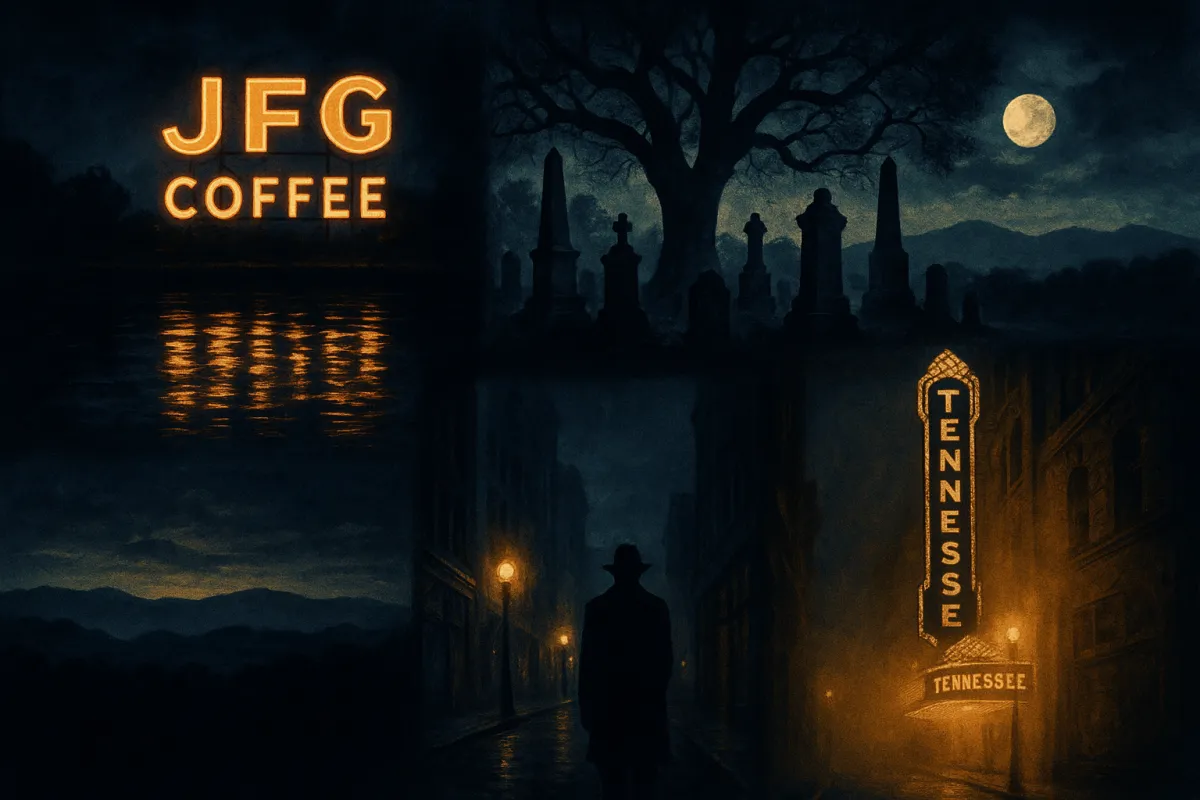
Just north of downtown Knoxville, Old Gray Cemetery is a little-known historic jewel. Founded in 1850 as part of the rural park cemetery movement, it became a popular destination for carriage rides and picnics in the Victorian era. The cemetery is named for English poet Thomas Gray, who penned Elegy Written in a Country Churchyard -- a fitting inspiration for a place where Knoxville's most dramatic decades left their most permanent marks.
The years 1860 to 1910, when most of the graves were dug, were some of the most violent decades of Knoxville's history. The cemetery is the final resting place of over 9,000 people -- from sufferers of the city's 1854 cholera outbreak to Union Civil War soldiers to victims of the 1904 New Market Train Wreck. Victorian marble statuary makes it one of the most visually extraordinary places in the city. It also holds something else.
Locals call him Black Aggie -- or sometimes Dark Aggie. He is described as a dark and shadowed apparition in a black robe, said to watch travelers as they move through the cemetery grounds. Stories of this figure hiding among the tombstones and wandering the property have circulated for decades. He is most common at dusk -- but more common, the stories say, for him to see you first.
The cemetery's ghost tours take a different approach. Local historian and storyteller Laura Still has said: The ghost stories, to me, are kind of very peaceful stories. There's nothing violent or evil about any of them. All of these people are people who actually lived. People like the beautiful artist Catherine Wiley -- Knoxville's best-known American Impressionist -- and her mentor Lloyd Branson, probably the city's first professional artist, who had a studio on Gay Street. Their names were linked in life; there were rumors of more than friendship. They are linked forever now, their final resting places side by side at Old Gray.
Old Gray serves as an arboretum with remarkable trees and plantings across its 13 rolling acres. Worth visiting in the daylight -- just watch what moves in the corner of your eye as the light shifts.
Sophie: The Ghost Who Never Leaves Strong Hall
The University of Tennessee's long history -- founded as Blount College in 1794 -- provides ample material for ghost stories. But the best-known campus legend centers on a person: Sophania Strong, who lived from 1817 to 1867 and was, by all accounts, a devoted mother, wife, and leading light of Knoxville society.
After her death, her son donated money to the University of Tennessee to build a women's dormitory on the site of the old family home. The result was Strong Hall -- and Sophie, as generations of UT students came to call her, never quite left the premises. She tends to appear around her birthday each year, February 17. One room in Strong Hall became so associated with psychic activity that it came to be called Sophie's Room, and it was rare that any mortal resident lasted out the semester there before moving out.
She is not the only UT ghost. Fanny, a theatrical spirit, haunted the Old Science Building before it was razed in 1979. Benita, the pet dog of former owners of Tyson Hall, is buried behind the building and can still allegedly be heard barking. The University of Tennessee campus has never had a shortage of loyal residents unwilling to leave.
The Curse of the White Mule
This one has the most gloriously Knoxville origin story of all the city's legends.
The Curse of the White Mule is one of Knoxville's more persistent downtown legends, going back to the mid-nineteenth century when a Gypsy circus came to town. The circus performed on the grounds of what is now the Downtown Grill and Brewery area of downtown -- and during one performance, the circus's prized and very rare white mule died, leaving a curse on the land.
The legend holds that the curse was localized to a specific block of downtown Knoxville -- and that strange and unfortunate things have happened on and around that block in the intervening decades. Some say the curse has been lifted. Others, firmly, say it has not. Whether or not you believe in circus curses, the detail that a Gypsy circus once came to Knoxville and performed on what is now a downtown restaurant site is historical fact worth savoring. The city has always had a gift for accumulating the improbable.
The Tennessee Theatre: Cold Spots in the Balcony
The Tennessee Theatre, a grand 1920s movie palace that opened in 1928, has long been rumored to host more than just performers. Staff have reported cold spots, malfunctioning lights, and the occasional shadowy figure in the balcony -- a figure that appears between performances when the house should be empty, and disappears when looked at directly.
Given that the Tennessee Theatre is one of the most exquisitely beautiful performance spaces in the American South, perhaps it is not surprising that whatever haunts it refuses to leave. If you had a reserved seat in a Spanish-Moorish movie palace with crystal chandeliers and ornate plasterwork, you might not be eager to give it up either.
Underground Gay Street: Tunnels Beneath the City
This legend has been generating conversations for years. The claim: that a network of tunnels runs beneath Gay Street, connecting various downtown buildings and perhaps dating back to the Civil War era or earlier.
Modern urban explorers and historians have investigated. Despite facing significant challenges such as collapsed sections and inaccessible areas, they have made intriguing discoveries -- evidence of old railroad tracks and remnants that suggest a network of tunnels indeed exists below Gay Street. Whether the full network is as extensive as legend suggests remains unresolved. But the bones of something are down there, under the street you walk every day.
The Literary Legends: Real Giants Who Walked These Streets
Not all of Knoxville's legends are supernatural. Some are human -- and in their own way, just as extraordinary.
Cormac McCarthy moved to Knoxville at age four in 1937, when his father came to work as a lawyer for the Tennessee Valley Authority. McCarthy would spend more than 30 years of his life in and around Knoxville, attending Knoxville Catholic High School and the University of Tennessee. His first published fiction appeared in the University of Tennessee's student literary magazine. His novel Suttree (1979) is a devastating and beautiful portrait of Knoxville circa 1950 -- the river, the waterfront, the down-and-out characters on the margins of a city that did not know what to do with them. McCarthy went on to win the Pulitzer Prize and the National Book Award. The Knoxville he described in Suttree is largely gone, but the book preserves it with an accuracy and love that no photograph could match.
James Agee was born in Knoxville in November 1909. His autobiographical novel A Death in the Family (1957), published posthumously and awarded the Pulitzer Prize, opens with one of the most celebrated passages in American literature -- a lyrical evocation of summer evenings in the Knoxville of his childhood, the sounds and smells of a specific place and time that no longer exists but that Agee made permanent.
Nikki Giovanni, one of America's most celebrated poets, was born in Knoxville in 1943. Though she moved soon after, she often visited her grandmother at 400 Mulvaney Street, and the city is woven through her early work. Her poem Knoxville, Tennessee, contained in her first book, is a bright and sensory celebration of summer in the city -- fresh corn, gospel music, the Smoky Mountains, the particular quality of being alive in East Tennessee.
Literary legends James Agee, Alex Haley, Cormac McCarthy, and Nikki Giovanni all lived in Knoxville at some time and each produced works referencing the city. That concentration of literary talent in a mid-sized Appalachian city is itself a kind of legend -- one that Knoxville does not always remember to celebrate loudly enough.
The JFG Coffee Sign: A Neon Legend
It is not a ghost story. It is not a curse. But in Knoxville, the JFG Coffee sign is a legend of its own kind.
The JFG Coffee sign -- a vintage neon beacon on the South Knoxville waterfront, visible across the river from downtown -- has been a fixture of the Knoxville skyline for decades. JFG stands for J. Friend and George, the original founders of a coffee company established in 1882. The sign became a landmark: its warm glow reflecting on the Tennessee River at night, reassuring in its constancy, a neon monument to a city that ran on coffee and the particular flavor of East Tennessee daily life.
The sign outlasted the company's original incarnation, survived proposals to remove it, and became one of those things that Knoxvillians defend with a ferocity disproportionate to what it technically is. It is just a sign. And yet it represents something about the city's relationship to its own continuity -- the stubborn insistence on keeping what is worth keeping, even when efficiency would argue for a clean slate. In a city full of stories, the JFG sign is the one that lights the river at night and asks nothing in return.
The James White Curse: Too Small to Grow
One final legend, smaller but persistent. James White, the founder of Knoxville, is said to have placed a curse on the city after land disputes led to disagreements with local settlers. The legend suggests that he cursed the area to never grow beyond a small town.
Knoxville has since defied that curse, growing into a significant and rapidly expanding city. But there is something in the city's relationship to its own smallness -- its pride in the Scruffy City identity, its resistance to becoming too polished or too large or too much like somewhere else -- that makes the legend feel like it describes something real, even if the curse itself is not. Maybe the curse was not a punishment. Maybe it was a wish.
The Stories That Stay
Every old city accumulates stories it cannot fully explain -- and cannot quite let go of. Knoxville's legends span the full range from documented hauntings to literary legacy to civic mythology, from a black-robed figure in a Victorian cemetery to a Pulitzer Prize winner who watched this river and wrote it into permanence.
What they share is a relationship to place that is deeply, specifically local. These are not generic ghost stories. They are Knoxville ghost stories -- tied to particular buildings, particular streets, particular people who lived and died and left something of themselves behind in the air.
The city's history is full of restless spirits, real and imagined. They have always been here. The Tennessee Theatre marquee is still lit. The JFG sign still glows across the river. Sophie still unsettles Strong Hall every February.
Some stories do not end. They just wait.
Explore more of Knoxville's history and hidden stories at Knoxville Right Now.
