A plain-language breakdown of the latest proposal, what it means for public space, traffic, and nearby neighborhoods.
If you've driven down Sevier Avenue lately and wondered what on earth is going on — or if you've heard the words "South Waterfront Master Plan" floating around city hall and the local news without a clear picture of what they actually mean — this post is for you.
A lot is happening along Knoxville's riverfront right now. Some of it is actively under construction. Some of it was just formally approved. Some of it is still years away. Here's a plain-language breakdown of what's in the works, what it means for everyday life in South Knoxville, and why the rest of the city should be paying attention too.
The Big Picture: A Plan Two Decades in the Making
Knoxville's riverfront ambitions aren't new. Building on nearly two decades of progress since the 2006 South Waterfront Vision Plan, the Tennessee River Waterfront Connectivity Framework Study — now renamed Reconnecting Knoxville — guides growth and connections across 750 acres and three miles of riverfront.
The latest major step came in March 2026, when the Knoxville City Council voted to adopt the South Waterfront Downriver Master Plan, a community-driven framework that will guide future development along the South Knoxville riverfront.
This wasn't a snap decision. "Overall, the process that began in January 2023 has been a positive one, thanks to those instrumental in ensuring the process remains a collaboration between the community and the city," said one South Knoxville resident who addressed the council in support of the plan. Over 400 community members gathered at the South Knoxville Open House in February 2023 alone, sharing ideas and priorities to guide the riverfront's transformation.
What the "Down River" District Actually Envisions
The newly adopted plan focuses on a specific stretch of South Knoxville riverfront. The "Down River" district extending west of the Henley Bridge to the Scottish Pike neighborhood is envisioned as a mix of new development and adaptive reuse, anchored by the future pedestrian bridge that will connect South Knoxville to the UT campus.
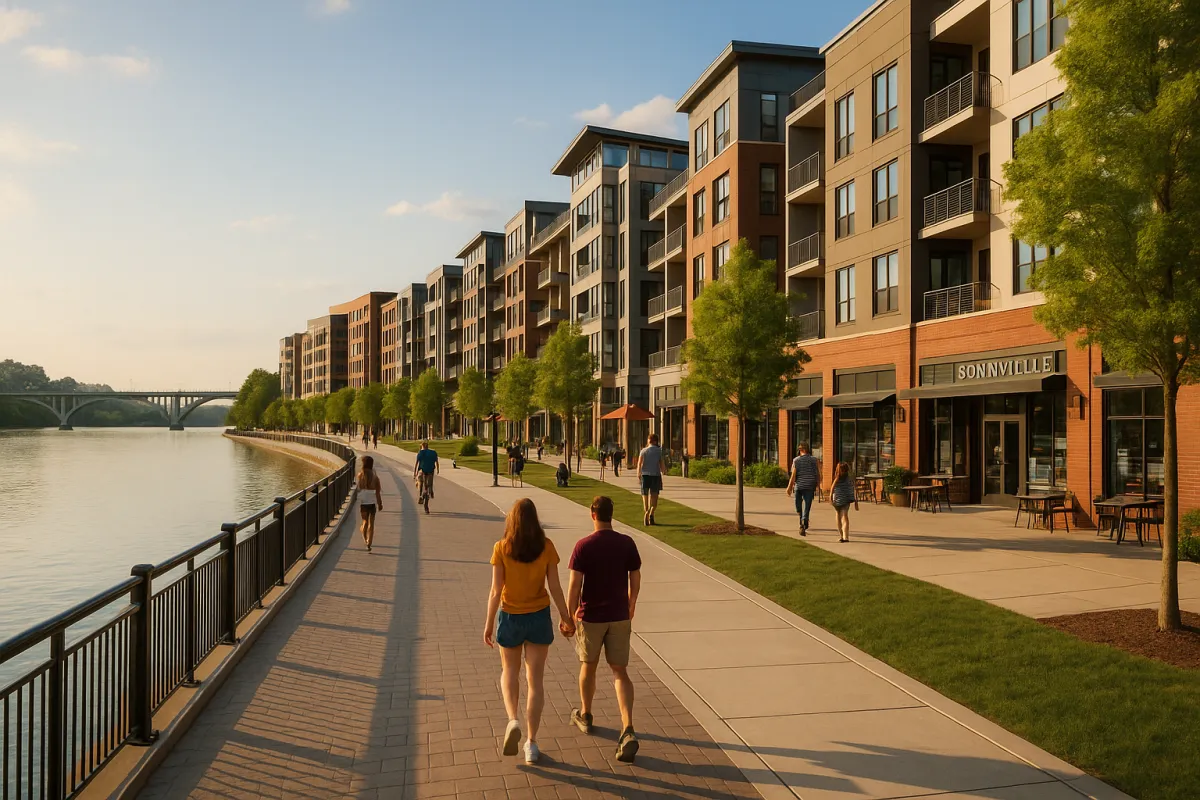
In practical terms, the plan imagines a neighborhood that looks and feels very different from what's there today. The concept imagines ground-floor retail, neighborhood amenities, gathering space along Blount Avenue, and a riverwalk tracing the shoreline, all intended to create walkable blocks and an active, human-scale streetscape.
Existing industrial structures — including two former Jefferson Mills buildings east of the bridge and the lower-profile warehouses to the west, once home to Specialty Metals & Supply — are shown as candidates for adaptive reuse rather than demolition.
The city isn't going to build this itself. It is looking for a private development partner through the Knoxville Community Development Corporation (KCDC), with a development partner expected to be selected by fall 2026. Critically, the majority of the downriver area is now controlled by KCDC, which community members said was a significant relief — meaning future development will be guided through a public institution with community accountability, rather than purely by private market forces.
What's Actually Under Construction Right Now: Sevier Avenue
While the master plan is still a vision, one major project is very much happening on the ground right now: the Sevier Avenue Streetscapes Project.
Construction began on the $19.2 million Sevier Avenue Streetscape Project in January 2025. The state is paying $7.9 million of the cost while the city covers $11.3 million. The target for completion is spring 2026.
So what exactly is being built? Here's the list:
- Overhead utility wires are being moved underground, removing the tangle of lines that have defined the street's visual character for decades.
- New bike lanes and ADA-compliant sidewalks are being added along the full corridor.
- A new roundabout is being installed at the Sevier Avenue intersection of Island Home Avenue and Foggy Bottom Street.
- New streetlights, traffic signals, and an upgraded railroad crossing are part of the package.
Once complete, the visual character of the street will change significantly. Wheelchair users will be able to move freely along the sidewalk without obstruction, and with overhead lines gone underground, the sight line for pedestrians will be cleaner and give more of a neighborhood feel.
What It Means for Traffic Right Now
Here's what people actually want to know: what does this mean for getting around?
During the 18-month construction period, expect some friction. New traffic patterns will be introduced during the construction period, including one-lane traffic, but no parts of the street will ever be fully closed. Flaggers are directing traffic when one lane is in use.
Businesses have had mixed feelings. Some business owners report that people are avoiding the area because the street is single-lane for most of the day. At the same time, Christopher Morton, CEO of Alliance Brewing Company, South Coast Pizza, and Old Sevier Market, reported record business during the construction period: "Everybody's doing great on Sevier Avenue — we're not missing a beat."
The city has been unambiguous on one point: access to businesses and South Knoxville Elementary School will consistently be maintained throughout the project.
The Gay Street Bridge — which historically served as the key connector between downtown and South Knoxville — adds another layer to the traffic picture. The bridge was closed for nearly a year due to safety concerns, but has since reopened to pedestrians and cyclists. Going forward, once fully reopened, only emergency vehicles and buses will be permitted to use the bridge for regular vehicle traffic.
The Pedestrian Bridge: A Game-Changer Still Coming
Perhaps the single most significant long-term project in the entire riverfront plan is a new pedestrian and bicycle bridge connecting South Knoxville directly to the University of Tennessee campus.
In January 2025, the City of Knoxville announced $24.7 million in RAISE Grant funding awarded to support the proposed bridge project. The total project budget is estimated at approximately $60 million. The pedestrian-bicycle bridge aims to provide more efficient, sustainable access to jobs, services, work, and school while maximizing pedestrian and bicycle safety across the Tennessee River.
This bridge is the anchor piece for the entire Down River district vision. Once it's in place, the calculus for development — and for everyday commuting between South Knoxville and the rest of the city — changes fundamentally.
The Rail-to-Trail Greenway: A New Off-Street Path
Running parallel to all of this is another project that will dramatically change how South Knoxville residents move through their neighborhood. A three-mile rail-to-trail greenway will run along the G&O Railway corridor from Chapman Highway to Mead's Quarry and the South Loop Trails of the Urban Wilderness. The trail will also feature a 1.5-mile Art Walk being developed by Legacy Parks Foundation.
"When this is finished, and the rail trail comes together, we'll have parallel paths that people can walk, bike, and just play on, safely, and connect them to local merchants," said one city official involved in the project.
What It Means for Neighborhoods
The riverfront improvements don't exist in a vacuum — they're reshaping what it's like to live, shop, and own a business in South Knoxville, and their effects will ripple beyond the immediate waterfront corridor.
The broader Reconnecting Knoxville framework helped Knoxville secure $42.6 million in Reconnecting Communities grant funding. The city will use these funds to create multi-modal networks that improve access to jobs, schools, parks, and cultural sites. Key projects include revitalizing a cultural corridor to honor Knoxville's Black history, transforming the James White Parkway into a linear park and urban wilderness connector, and ensuring equitable access to the South Waterfront.
Community members have been consistent about what they want the neighborhood to remain. The guiding principles of the original 2006 Vision Plan are considered non-negotiable: preserving green space, mixed-income housing, access to the waterfront, and maintaining the intent of the form-based code.
Not everyone is fully satisfied, however. Councilmember Amelia Parker abstained from the March 2026 City Council vote, citing concerns rooted in her experience as a lifelong South Knoxville resident. She pointed to the University of Tennessee's history of expansion through eminent domain into Fort Sanders and University Avenue as a reason for caution about applying an economic development lens to the South Waterfront. These are legitimate concerns worth watching. Riverfront development has displaced communities in other American cities, and the question Knoxville has to answer — and is actively debating — is whether this transformation will serve the people already here, or primarily attract those who haven't arrived yet.
The Bottom Line: What's Changing and When
| Project | Status | Timeline |
|---|---|---|
| Sevier Avenue Streetscape ($19.2M) | Under Construction | Completion spring/mid-2026 |
| Gay Street Bridge | Reopened to pedestrians & cyclists | Open now |
| South Waterfront Downriver Master Plan | Adopted by City Council | Developer partner selected fall 2026 |
| Pedestrian Bridge — South Knoxville to UT ($60M) | Funded, planning phase | Multi-year project |
| Rail-to-Trail Greenway (3 miles) + Art Walk | Pre-construction | Construction beginning soon |
| Down River District Development | RFQ/Partner Search | Partner selection fall 2026 |
The short version: South Knoxville's riverfront is in the middle of the biggest transformation it has seen in decades — and possibly ever. There will be construction headaches in the near term. There will be legitimate debates about affordability, access, and who all of this is really for. But the long-term vision — a connected, walkable, publicly accessible waterfront that belongs to Knoxville residents — is one that has been shaped by real community input over more than two years of sustained engagement.
Whether it lives up to that vision is a story still being written.
Stay up to date on Knoxville civic news at Knoxville Right Now.
