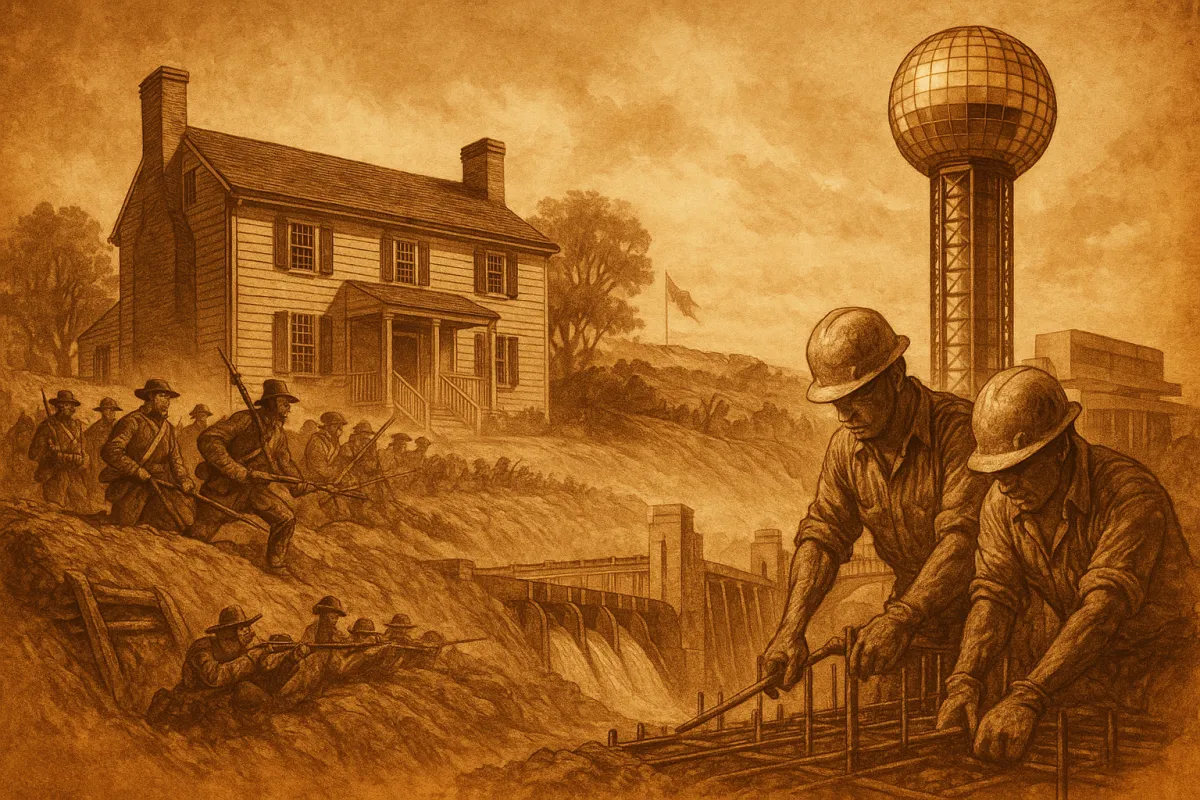
A Timeline of the Turning Points That Made Knoxville What It Is Today
Every city is the sum of its history — the decisions made, the conflicts endured, the visions pursued and sometimes lost. Knoxville, Tennessee is no exception. From Cherokee trade routes to the atomic age, from a devastating fire to a World's Fair, the city's story is rich, complicated, and worth knowing. Here is a chronological journey through the defining moments that shaped Knoxville's identity and charted its growth.
Pre-1780s — The Cherokee World Before the City
Before a single European settler drove a stake in the ground along the Tennessee River, this land belonged to the Overhill Cherokee. Their towns — including Chota, Toqua, and Tanasi (from which "Tennessee" derives) — lined the region's rivers and represented a sophisticated civilization of diplomacy, agriculture, trade, and culture.
European contact, beginning in the mid-1700s, brought both exchange and conflict. Traders, missionaries, and soldiers moved through Cherokee territory with increasing frequency, and the pressure of colonial expansion steadily encroached on Cherokee sovereignty. Understanding Knoxville's history honestly requires beginning here — with the people whose world was displaced to make it possible.
1786 — James White Builds His Fort
The story of Knoxville as a European American settlement begins with James White, a Revolutionary War veteran who constructed a log blockhouse along the north bank of the Tennessee River in 1786. "White's Fort" served as a gathering point for settlers venturing into the western frontier and laid the physical and symbolic foundation for what would become the city of Knoxville.
White's decision to settle at this particular bend in the river — where the Holston and French Broad rivers converge to form the Tennessee — was no accident. The geography was strategic: defensible, fertile, and connected to water trade routes that extended in multiple directions. Almost everything that came after flows from this single, practical choice.
1791 — Tennessee's First Capital
When Governor William Blount established the territory that would become Tennessee, he chose Knoxville as its seat of government. The city became the capital of the Southwest Territory and, when Tennessee achieved statehood in 1796, served as the new state's first capital.
Blount Mansion, still standing on Hill Avenue today, was Blount's residence and the political center of a vast frontier territory. The mansion is one of the first frame houses built west of the Appalachian Mountains and now operates as a National Historic Landmark and museum. This brief chapter as state capital gave Knoxville a stature and ambition that shaped its civic identity for generations — even after Nashville eventually claimed the capital in 1812.
Early 1800s — The Railroad Arrives and Changes Everything
The arrival of the railroad in Knoxville in the 1850s transformed the city from a river-dependent regional hub into a connected commercial center. The East Tennessee and Georgia Railroad linked Knoxville southward; the East Tennessee and Virginia Railroad connected it north and east. Suddenly, goods, people, and ideas moved faster and farther than the Tennessee River alone could carry them.
This era of railroad expansion supercharged Knoxville's growth and made it the dominant commercial city of East Tennessee. Manufacturing expanded, warehouses lined the waterfront, and a merchant class emerged that would fund the civic institutions — banks, newspapers, schools — that gave the city substance and permanence.
1861–1865 — The Civil War Divides the City
No chapter in Knoxville's history is more complicated — or more revealing of its character — than the Civil War. Tennessee as a whole seceded from the Union, but East Tennessee was a profoundly Unionist region. Families were torn apart. Neighbors became enemies. Union sentiment ran so strong here that many East Tennesseans actively resisted Confederate authority, harboring escaped Union soldiers and sabotaging Confederate infrastructure.
The climactic military event was the Siege of Knoxville in November–December 1863. Union General Ambrose Burnside defended the city against Confederate General James Longstreet in a weeks-long standoff that ended in Confederate withdrawal. The Battle of Fort Sanders — a Confederate assault on a Union earthwork fortification — lasted only 20 minutes but resulted in devastating Confederate casualties and secured the Union hold on the city.
The Civil War left Knoxville physically scarred and emotionally fractured. But the Unionist identity of East Tennessee also created a distinct regional culture — independent, skeptical of authority, proud of its dissent — that still flavors the character of Knox County today.
1897 — The Great Fire
On a spring afternoon in April 1897, fire broke out in downtown Knoxville and swept through the commercial district, consuming dozens of blocks before it was contained. The Great Knoxville Fire destroyed much of the city's Victorian-era commercial core and forced a wholesale rebuilding of downtown.
Rather than retreating from the disaster, the city rebuilt with ambition. The Gay Street corridor that emerged in the years following the fire featured substantial brick and stone commercial buildings — many of which still stand today — and gave Knoxville's downtown the architectural bones it retains more than a century later. Catastrophe, in this case, became the foundation for a more durable city.
1933 — TVA and the New Deal Transform the Region
When President Franklin D. Roosevelt signed the Tennessee Valley Authority Act in 1933, Knoxville became the institutional home of one of the most ambitious federal programs in American history. The TVA's mission — to bring electrical power, flood control, economic development, and modernization to the chronically impoverished Tennessee River Valley — fundamentally changed Knoxville and the entire region.
TVA dams reshaped the landscape. Norris Dam, completed in 1936 as the first of many, created a new geography of lakes, managed waterways, and recreational opportunities. Electricity reached rural communities that had never had it. Jobs flooded into a Depression-era economy desperate for them. Knoxville, as TVA headquarters, attracted engineers, planners, scientists, and federal employees who built careers and communities here.
The TVA era gave Knoxville a lasting identity as a city of energy, science, and public investment — an identity that would be reinforced dramatically just a decade later.
1943 — The Secret City Next Door
During World War II, the federal government quietly constructed an entire city 25 miles from Knoxville. Oak Ridge — built from scratch, not listed on any map, and populated by tens of thousands of workers who couldn't tell their families what they were doing — was the uranium enrichment hub of the Manhattan Project. The atomic bomb dropped on Hiroshima was built, in significant part, with materials processed at Oak Ridge.
Knoxville knew something extraordinary was happening nearby — the sudden flood of workers, the mysterious security cordons, the rationing of local resources — but the full picture didn't emerge until after the war ended. The revelation that Knoxville's neighboring city had helped end World War II left an indelible mark on the region's sense of identity and purpose. Oak Ridge's legacy as a center of scientific research continues to influence Knoxville's economy and intellectual culture today.
1982 — The World's Fair Puts Knoxville on the Global Map
In the summer of 1982, Knoxville did something that surprised the entire country: it hosted a World's Fair. The Knoxville International Energy Exposition ran from May through October and drew over 11 million visitors from around the globe to a transformed swath of land just west of downtown.
The Sunsphere — a golden geodesic orb atop a steel tower that remains Knoxville's most recognizable landmark — was built for the fair and still stands in World's Fair Park. The event left behind not just infrastructure but confidence. Knoxville had proven it could organize, invest in itself, and welcome the world. World's Fair Park today is a hub for festivals, concerts, and community gatherings, and the surrounding area owes its vitality in no small part to the energy the 1982 event injected into downtown.
1990s–2000s — The Downtown Renaissance
For much of the late 20th century, downtown Knoxville struggled with the familiar urban challenges of suburban flight, commercial vacancy, and disinvestment. The comeback has been remarkable. Beginning in earnest in the late 1990s and accelerating through the 2000s, downtown Knoxville underwent a transformation driven by private investment, city planning, and a genuine community desire to reclaim the urban core.
Market Square became the social heart of the city. The Old City neighborhood was reborn as a nightlife and arts district. Gay Street filled with restaurants, galleries, and boutique hotels. Today, downtown Knoxville is regularly cited as one of the most successfully revitalized downtowns in the mid-sized American city category — a model that other cities study.
Today — A City in Motion
Knoxville in 2026 is a city that understands its past without being imprisoned by it. The Cherokee legacy is being more honestly acknowledged. The Civil War's complexities are actively debated and documented. The TVA and Oak Ridge traditions of scientific ambition continue in new forms at the University of Tennessee and through Innovation Valley's growing tech ecosystem.
And through all of it, the Tennessee River keeps flowing — as it has through every chapter of this story, shaping, sustaining, and defining the city on its banks.
