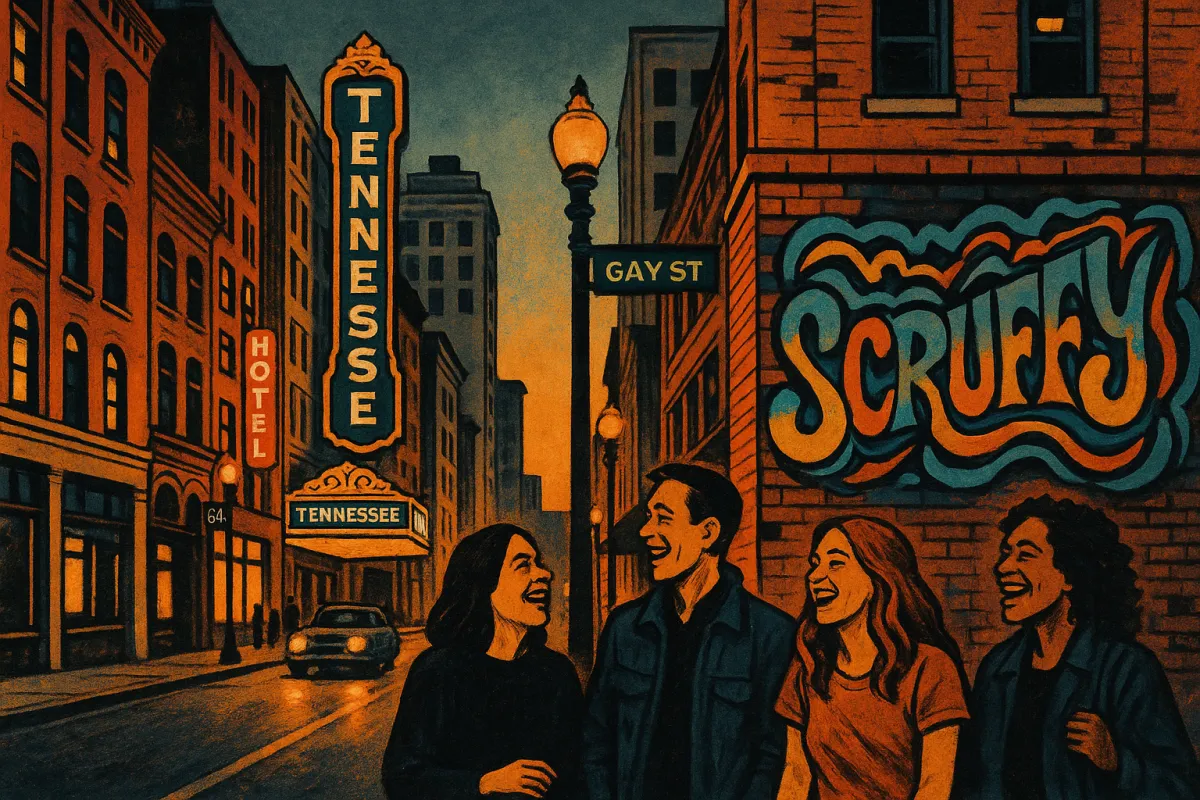
The story of two words that infuriated a city, defined a generation, and became the most Knoxville thing Knoxville has ever done.
Every city has a nickname. Most of them are forgettable. Chicago is the Windy City. Nashville is Music City. And then there is Knoxville, where the nickname came from a national newspaper calling the city a scruffy embarrassment -- and where the locals' response to that insult turned out to be one of the most authentically Appalachian things this city has ever done.
This is the full story of how Scruffy City went from a dismissive sneer on the front page of the Wall Street Journal to a bumper sticker, a bar name, a radio show, a vegan food festival, and a civic identity that Knoxville wears with more genuine pride than any slogan a marketing firm could ever generate.
December 29, 1980: The Article That Started Everything
To understand the nickname, you have to understand the moment. It was two years before the 1982 World's Fair was set to open in Knoxville -- the first World's Fair ever held in the American South, and at the time, a wildly ambitious bet for a mid-sized Appalachian city that the rest of the country was not entirely sure could pull it off.
The skepticism was real. The nation's press had questions. And then, on December 29, 1980, the front page of the Wall Street Journal ran an article by reporter Susan Harrigan headlined: What If You Gave A World's Fair And Nobody Came?
The article questioned and criticized the decision to let Knoxville host the World's Fair, writing about Knoxville's image, the hesitancy of corporations and countries to attend, and the event's organizers. A few paragraphs in, the fateful words appeared.
Nevertheless, with visions of international exotica dancing in their heads, leaders of this scruffy little city of 180,000 on the Tennessee River are churning out breathless press releases comparing Knoxville to such previous world's fair hosts as Paris or New York.
-- Susan Harrigan, Wall Street Journal, December 29, 1980
Two words. Scruffy little. That was all it took.
Knoxville historian Jack Neely pointed out that the piece was not the only article criticizing Knoxville and the World's Fair -- publications that piled on included Time, Newsweek, and even The Tennessean in Nashville. But none of those other slights landed the same way. Scruffy little city was specific. It was dismissive. It had a cadence to it. And it stuck.
Out of all the negative press, the phrase stayed on Knoxville's mind. The phrase became widely known almost immediately, infuriating some, and was on T-shirts during the World's Fair, Neely later wrote.
Worth noting: a researcher later discovered that this was not even the first time the phrase had been used. Another writer had called Knoxville the scruffy little city back in 1947 -- decades before Harrigan made the same remark in the Journal. The insult had been lurking in the national press's vocabulary for a generation. Harrigan just happened to say it loudest, on the biggest stage.
1982: The Scruffy Little City Proved Everyone Wrong
Here is the thing about the Wall Street Journal's question -- what if you gave a World's Fair and nobody came?
They came.
On opening day alone, May 1st, 1982, the fair hosted 87,000 people, and opening week saw 387,000 people. Overall, 11 million people from across the world traveled to Knoxville to visit the fair. The 1982 World's Fair Exhibition is considered by many to be the last successful World's Fair held in America -- and the South's first World's Fair.
President Ronald Reagan opened the fair at the Court of Flags with Dinah Shore serving as master of ceremonies. As the gates opened, there were performances by Porter Wagoner and Ricky Skaggs. Other notable guests included Bob Hope and the Crown Prince of Jordan Hassan bin Talal.
The fair transformed the city physically. The abandoned 70-acre Louisville and Nashville Railroad Yard between Downtown Knoxville and the UT campus was completely renovated. The Sunsphere -- the fair's iconic structure -- stands 266 feet high, 26 stories tall, with a gold globe whose panes of glass are made from 24-karat gold. Many notable businesses and innovations made their debut at the 1982 fair: among them Petro's Chili and Chips, Texaco's concept of pay at the pump, Coca-Cola's Cherry Coke flavor, and the budding concept of touch screens.
The fair cost the city $46 million and turned a total profit of exactly $57 dollars. Yes, fifty-seven dollars. The books balanced. Barely. But they balanced.
And when it was over? Fair officials created commemorative buttons that stated The Scruffy Little City Did It. World's Fair organizers and city officials could have brushed off the original comment -- but instead, they embraced it. Tourism Commissioner Etherage Parker told the press in 1982: You've made us proud... making a scruffy little city here in East Tennessee known all over the world.
The insult had been reclaimed. The transformation from wound to war paint took less than two years.
The Scruff Spreads: A Cultural Snowball
What happened next was quieter, slower, and in many ways more interesting than the World's Fair itself. The phrase did not fade. It multiplied.
Over the following decades, Scruffy City embedded itself into Knoxville's cultural identity in the organic, uncoordinated way that real civic identity always forms -- not through a branding campaign, but through a thousand small acts of local pride.
WUTK started a radio show called Scruffy City Rambler, while Knoxville journalist Jack Neely launched his talk show The Scruffy Citizen -- a podcast series that ran to nearly 80 episodes. Scruffy City Hall, a local bar in the Market Square area of Downtown Knoxville, became one of the biggest supporters of the Scruffy City legacy. The name grew exponentially, taking its spot in the names of bars, music and film festivals, and local events such as the Scruffy City Vegan Fest. It appeared in countless slogans, bumper stickers, T-shirts, and other Knoxville merchandise.
Then came Keep Knoxville Scruffy -- perhaps the most perfect civic slogan in Tennessee history. Jack Neely noted that the phrase was created by Scott and Bernadette West, owners of Preservation Pub, as a reaction to the Keep Austin Weird movement. Knoxville's take on the idea provided local flavor, but the history behind those three words lent much deeper context. Earth to Old City began their line of Keep Knoxville Scruffy merchandise, starting with T-shirts before expanding to hoodies, bags, cozies, and anything else the slogan could go on.
Several businesses named themselves using the phrase, including Scruffy City Hall and Scruffy City Construction. The Scruffy City Orchestra -- volunteer-based and community-funded -- formed. The Scruffy City Film Festival brought independent cinema to the city. In 2014, Scruffy City Hall opened on Market Square, turning a former boutique into what local media called probably the coolest space in Knoxville.
What Scruffy Really Means
Ask a Knoxvillian what scruffy means to them and you will get different answers -- but they tend to orbit the same ideas. Unpretentious. Independent. A little rough around the edges in ways that turn out to be features, not bugs.
Name-calling by the national press resulted in collective action that is often associated with Appalachian sensibilities: self-reliance grubbed out of grit, pride of heritage, an unkempt sense of humor, and a rumpled, slightly distrustful outlook toward those who look down from a distance and issue verdicts about places they do not understand.
The East Tennessee character -- forged by mountains, by self-sufficiency, by a history of being underestimated and proving doubters wrong -- found a word that fit. And when a reporter from a New York financial newspaper handed them that word as an insult, they did what Appalachian people have always done with things handed down from on high with condescension. They kept it. They made it their own. They made it better.
We don't need to be fancy and polished -- the Knoxville consensus, 1982 to present.
The Debate That Never Quite Dies
It would be dishonest to pretend the nickname has been universally embraced without complication. In 2018, commentators wondered whether Knoxville still wanted to be called scruffy. Members of one civic advisory board worried that scruffiness was not conducive to development in a sleek metropolis.
It is a fair tension. Knoxville is growing. The downtown that was scrappy and half-empty in 1982 is now genuinely vibrant -- a revitalized urban core with boutique hotels, nationally recognized restaurants, and a tech economy drawing talent from around the country. Does a city succeeding at that level still need to identify with a word that originally meant rough and unfinished?
Knoxville historian Jack Neely, who has thought about this question more carefully than almost anyone, lands somewhere that feels right: Knoxville's a whole lot more obviously impressive today than it was in 1980, but I think it still has some scruff to it, and always will. And I think that's what some people like about it.
The scruff, in this reading, is not about being underdeveloped. It is about not caring too much what the Wall Street Journal thinks. It is about the Farmers' Market vendors who have been there since the beginning. It is about the dive bar where the best bluegrass you have ever heard happens on a random Tuesday. It is about the city that hosted 11 million visitors at a World's Fair and made exactly fifty-seven dollars in profit and was proud of it anyway.
The Legacy: A Timeline
| Year | What Happened |
|---|---|
| 1947 | First known use of scruffy little city in print -- decades before the WSJ |
| Dec 29, 1980 | Wall Street Journal publishes the article. Two words change a city's identity forever. |
| May 1, 1982 | World's Fair opens -- 87,000 visitors on Day One alone |
| Oct 1, 1982 | World's Fair closes -- 11 million total visitors; buttons printed: The Scruffy Little City Did It |
| 1995 | National press officially concedes: the scruffy city got its revenge |
| 2010 | Jack Neely launches The Scruffy Citizen podcast; WUTK hosts Scruffy City Ramble radio show |
| 2012 | Scruffy City Roots live variety show broadcasts on television |
| ~2012 | Keep Knoxville Scruffy launched; merchandise expands citywide |
| 2014 | Scruffy City Hall opens on Market Square |
| 2018 | The great debate: is Scruffy still the right identity for a growing city? |
| 2022 | East Tennessee Historical Society hosts a scruffy little exhibition on the World's Fair |
| Today | The Scruffy City Orchestra plays on. The bumper stickers are everywhere. The debate continues. |
The Bottom Line
Here is the version of the story worth telling in one sentence: a reporter from a big national paper dismissed a small Southern city in 1980, and that city spent the next four-plus decades proving her wrong -- and wearing the dismissal as a crown.
That is a great story. It is a story about defiance and humor and the particular kind of pride that comes from a community that has always had to argue for its own worth. It connects the 1982 World's Fair to a bar on Market Square to a T-shirt in the Old City to a bumper sticker on a pickup truck climbing Chapman Highway.
Forty-five years later, when the reporter called Knoxville a scruffy little city, residents decided to wear the insult as a badge of honor -- and still do. That is still true. And it still feels exactly right.
Stay scruffy, Knoxville.
Explore more of Knoxville's history and culture at Knoxville Right Now.
