Beyond the Orange — Knoxville's Rich Layers of Business, Art, History, and Family
When most people hear "Knoxville," their minds jump almost immediately to one image: a sea of orange-clad fans packing Neyland Stadium on a crisp autumn Saturday. And while Tennessee Volunteers football is absolutely a part of the city's heartbeat, leaning on that single identity does Knoxville a profound disservice. This is a city of surprising depth — a place where a booming entrepreneurial economy, a world-class arts scene, centuries of fascinating history, and a remarkably livable quality of life all exist side by side, often unnoticed by the rest of the country.
It's time to correct that.
A Business Community Built to Last
Knoxville's economy didn't grow up around the University of Tennessee. It grew up around energy, manufacturing, logistics, and healthcare — and today it's one of the most quietly dynamic mid-sized business cities in the American South.
The Tennessee Valley Authority (TVA), headquartered in Knoxville, has shaped not just the region's power grid but its entire economic DNA since the 1930s. TVA brought federal investment, engineering talent, and infrastructure that drew industry and innovation to East Tennessee for generations. That legacy lives on today in a thriving advanced manufacturing sector, with companies like Regal Beloit, Pilot Flying J (one of America's largest private companies, headquartered right here), and a growing tech corridor filling out the city's economic landscape.
The entrepreneurial ecosystem is accelerating fast. Innovation Valley — the economic development initiative anchored by the University of Tennessee and Oak Ridge National Laboratory — has positioned Knoxville as a legitimate hub for energy technology, cybersecurity, and scientific research. Oak Ridge, just 25 miles away, is home to some of the world's most powerful supercomputers and continues to draw researchers, startups, and federal investment into the broader Knoxville metro.
Downtown Knoxville has also experienced a remarkable commercial renaissance over the past two decades. The Market Square district and the Old City neighborhood are alive with locally owned restaurants, boutiques, tech startups, and coworking spaces. This isn't a college-driven economy — it's a grown-up city making confident, long-term bets on itself.
The Arts Scene Nobody Talks About Enough
Ask a Knoxvillian about the arts and watch their eyes light up. The city punches well above its weight when it comes to creative culture, and it has for a long time.
The Tennessee Theatre, a stunning 1920 Spanish-Moorish movie palace on Gay Street, is one of the most beautiful historic venues in the Southeast. The Knoxville Museum of Art anchors the World's Fair Park with rotating exhibitions and a permanent collection that spans centuries and continents. The Clarence Brown Theatre — affiliated with UT but beloved far beyond campus — produces professional-caliber performances year-round.
Knoxville's music heritage deserves its own conversation. The city has deep, tangled roots in old-time, bluegrass, and country music. The Bijou Theatre has hosted legends ranging from Hank Williams Sr. to more recent touring artists. The Market Square Farmers' Market and the Dogwood Arts Festival each spring bring thousands together in celebration of local creativity. And the Old City's live music venues offer a nightly soundtrack that reflects both Appalachian tradition and thoroughly modern indie sensibility.
Perhaps most telling: Knoxville has produced a remarkable number of writers, musicians, and visual artists who carry the city's character in their work — including author Cormac McCarthy, who was born here and whose brooding Appalachian landscapes owe much to East Tennessee's particular light.
A City Steeped in History
Long before the first kickoff in Neyland Stadium, Knoxville was making history that mattered far beyond its borders.
Founded in 1786 and serving as the first capital of Tennessee before Nashville claimed the title, Knoxville carries the weight of genuine American frontier heritage. The city sits at a crossroads that Native Americans — particularly the Cherokee — used for centuries before European settlers arrived. The Overhill Cherokee had a rich civilization in this region, and that history, though often overlooked, is woven into the city's very geography.
During the Civil War, Knoxville was a deeply divided city in a deeply divided state. East Tennessee was largely Unionist in sentiment while the rest of the state sided with the Confederacy, a fault line that created genuine anguish and fascinating historical complexity. The Siege of Knoxville in 1863 left its mark on the city's landscape and memory.
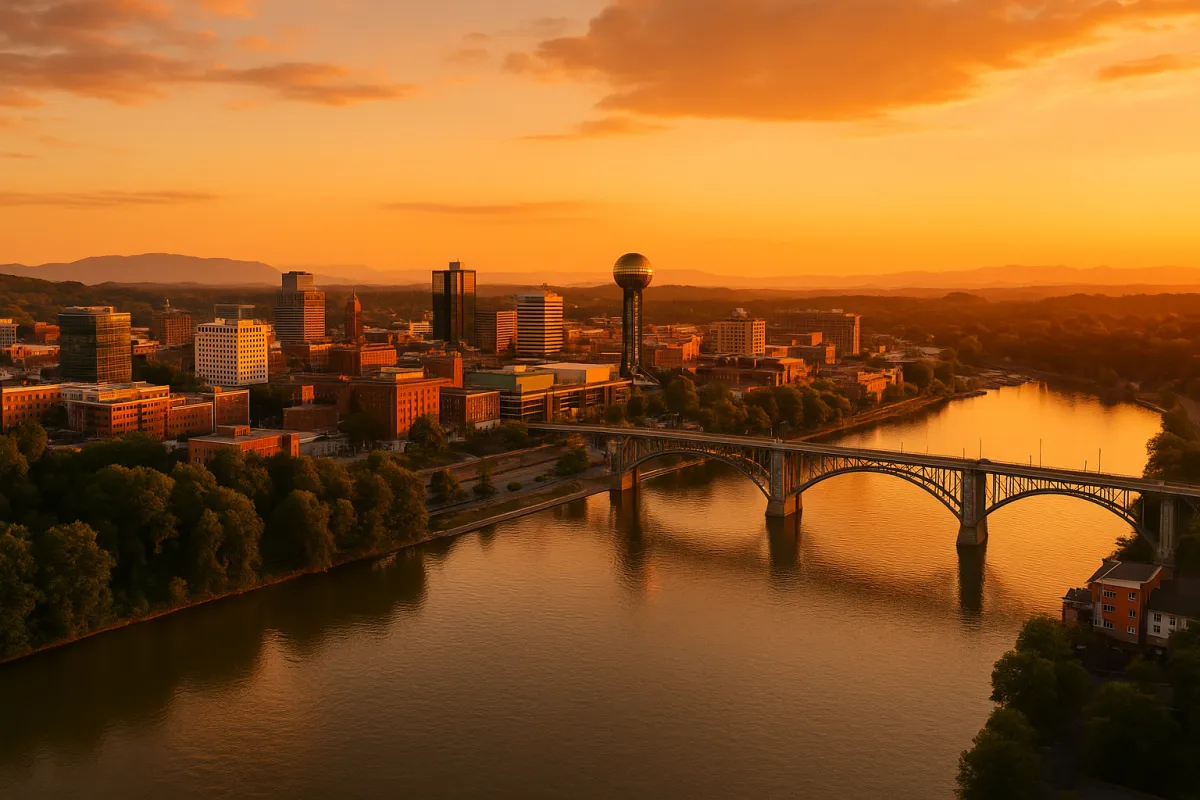
The 1982 World's Fair — officially the Knoxville International Energy Exposition — drew more than 11 million visitors and left behind the iconic Sunsphere, World's Fair Park, and a lasting sense that Knoxville was capable of hosting the world on its own terms. That event catalyzed the downtown revival the city continues to build on today.
Family Life in the Gateway to the Smokies
Here's what often surprises people who move to Knoxville from larger cities: it is an extraordinarily good place to raise a family.
The cost of living is significantly below the national average. The school system has strong magnet programs and is increasingly investing in STEM education. The outdoor access is simply unmatched — Great Smoky Mountains National Park, the most visited national park in the country, is less than an hour from downtown. Urban Wilderness, a 1,000-acre network of trails and parks within city limits, means you don't even have to leave town to find a waterfall.
Knoxville's neighborhoods each have distinct personalities. Bearden offers walkable dining and boutiques. Sequoyah Hills lines the Tennessee River with grand mid-century homes and shaded sidewalks. North Knoxville has emerged as a hotbed of young professionals and renovated bungalows. Every family finds its place.
There's also a genuine sense of community here — the kind that larger metros often lose. The Tennessee vs. Alabama game may bring the city to a standstill twice a year, but it's the Saturday mornings at Market Square, the neighborhood block parties, and the front porch culture that makes Knoxville feel like home 365 days a year.
The Bottom Line
Knoxville doesn't need the football stadium to be interesting. It needs visitors and newcomers to simply look a little longer — to walk past the merchandise shops and into the art galleries, the independent bookstores, the waterfront trails, and the historic neighborhoods beyond. What they'll find is a city with genuine character, a real economy, a proud creative culture, and a quality of life that's quietly one of the best-kept secrets in the American South.
The orange is just the beginning.
